CMS HCD Guidebook- A Research Driven Redesign
Through generative and evaluative research, our team reimagined this central resource and increased usage by 85%

The Challenge
Our team aimed to support designers and researchers within the Center for Medicare & Medicaid Services (CMS) with a Human Centered Design Guidebook that served as both an onboarding resource and a collection of best practices.
Upon learning that this guidebook was underutilized and inefficient, we set out to retool and redesign the guidebook into a more effective and relevant resource for the designers and researchers we served.
The Human Centered Design Unification Team
The Human-Centered Design Unification Team (HCDU) was a team within the Center for Medicare & Medicaid Services (CMS) created to serve and support 11 other independent teams within the CMS ecosystem. Collectively, this unit of teams was referred to as "MACBIS" (Medicaid and CHIP Business Information Solution products).
We supported these teams through:
- Facilitating a digital centralized repository for design and research operations
- Providing ad-hoc Human-centered design support for teams, projects and individuals who needed it, and
- Building and maintaining a community of practice to promote knowledge sharing, remove silos, and empower the 11 other teams within MACBIS
Team Goals and Ecosystem
I joined this team in September 2023, shortly after they had begun to support these initiatives. During my time with this team, we took great strides in tailoring and improving the way we supported teams within MACBIS.

We established success Check-ins with 8 of the 11 teams, which we provided personalized support for team members, which allowed us to assist over-capacity teams and combat team member burnout. We heard about internal and external blockers teams were facing, which allowed us to communicate the persistent problems affecting multiple teams to product owners at CMS, and advocate for more thorough support.

We established a Community of Practice, creating a place for connection that broke down a siloed environment as teams discussed solutions and challenges out in the open with other HCD professionals. Over the course of one year, Community of Practice attendance grew by 73%, and on average, 71% of attendees rated the Community of Practice as "Very Helpful"

We created and maintained a Human-Centered Design (HCD) guidebook, a comprehensive internal knowledge bank for HCD practitioners within MACBIS. This guidebook contained guides for the complicated processes and bureaucracies of MACBIS, a step by step onboarding guide for new team members, and tools and templates for design, research, content strategy, and accessibility.
What is the HCD Guidebook?
The HCD Guidebook is a central resource for HCD Practitioners within MACBIS, and a cornerstone of the work our HCDU team delivered. While it served many needs, the two most prevalent were:
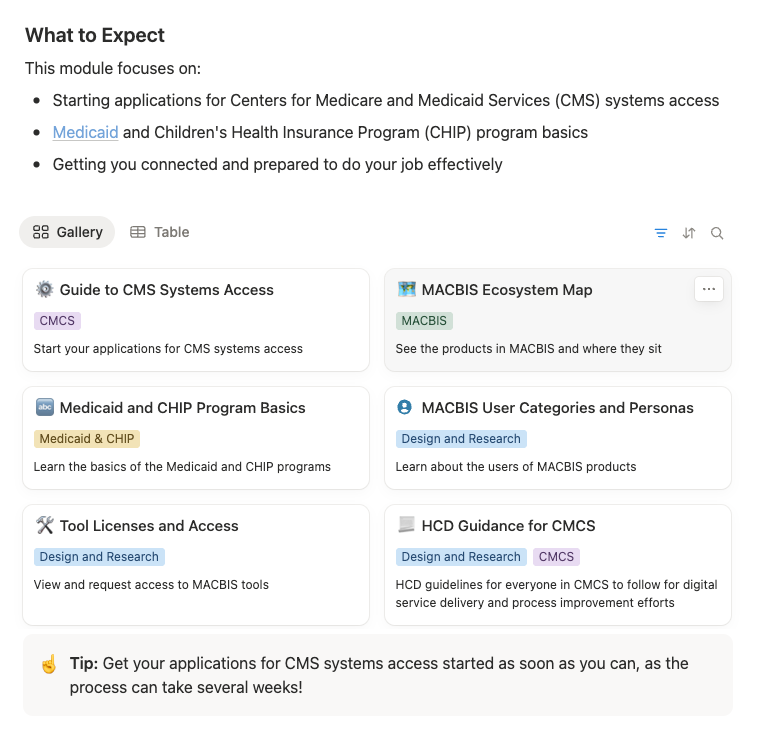
An onboarding resource for newcomers to the MACBIS ecosystem.
The wealth of information about CMS Programs, relationship between teams in MACBIS, and our ways of working were broken down into bite-sized "modules" to help newcomers get up to speed gradually.
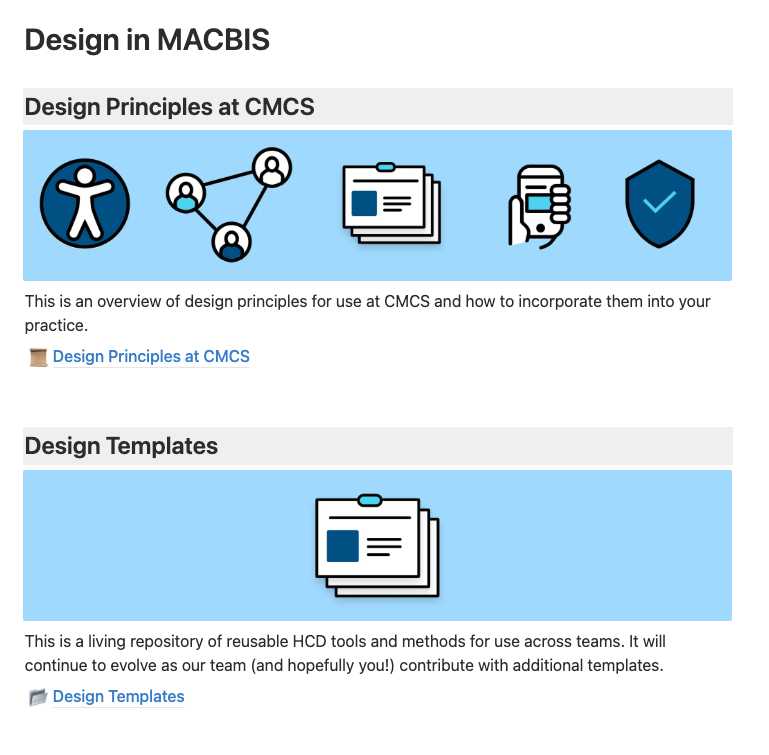
A tool to help MACBIS HCD teams follow best practices.
It provided access to shared resources like templates and asset libraries, guides on the best ways to work with stakeholders most effectively, and examples to refer to in their work.
As our HCDU team gathered feedback from other teams in MACBIS and reflected on our service offerings, we agreed that the HCD guidebook could be more relevant, more accessible, and feature more tailored content for its audience.
In September 2023, my colleagues (Chris Oliver, Paul Weiss, Rebecca Bruno, Kit Miklik, Laura Blumenthal, Charnell McQueen) and I on the HCDU team began the process of transforming the HCD Guidebook.
Research & Iteration Process
Transforming the HCD Guidebook needed to begin by gaining a clear understanding of the needs, expectations, and reality of our users. To better understand these needs and expectations, we conducted a round of generative research, starting with user interviews.
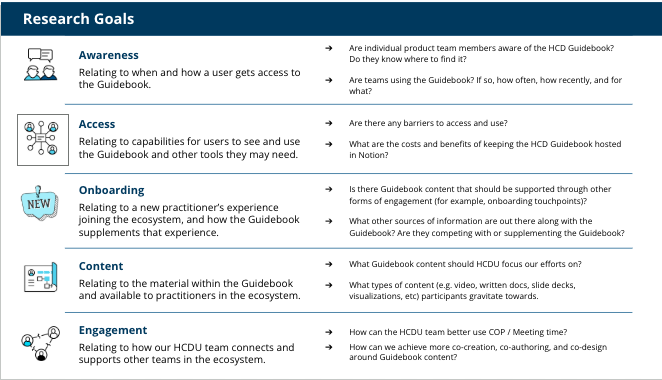
We organized our research goals into five sections that encompassed relevant factors to the Guidebook: Awareness, Access, Onboarding, Content, and Engagement.
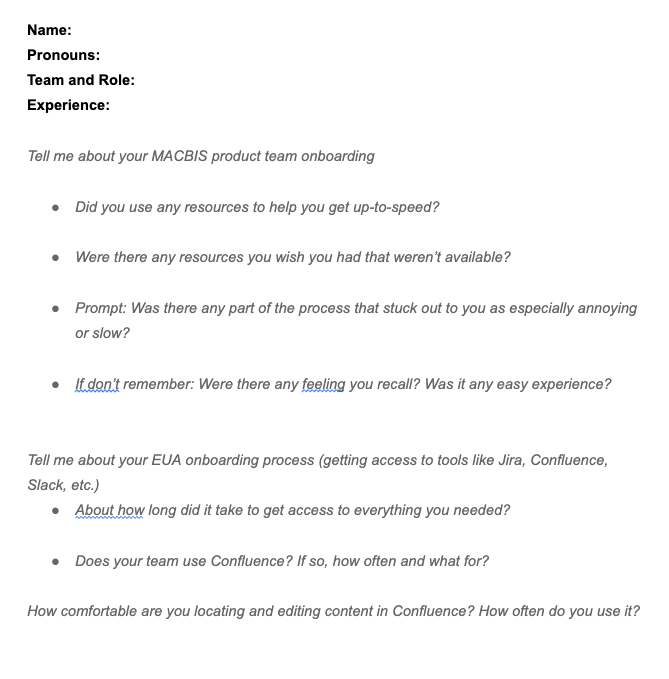
Next, we conducted hour long interviews with eight practitioners and two product managers, where we sought to understand if and how the guidebook played a role in their onboarding experience, daily project work, and their team's relationship with the HCDU team.



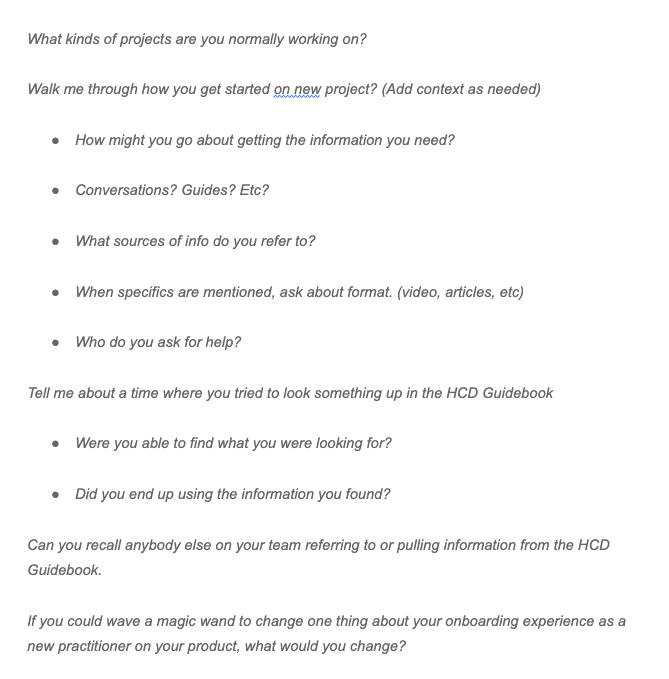
From these interviews, we synthesized what we heard into 5 main insights, which we which we reviewed among our team and shared out with both CMS leadership and the community of MACBIS practitioners.
Gaps in communication when the Guidebook is first introduced can leave users without direction and purpose, and disincentives them from fully exploring its contents.
“I didn't feel like there was a directive when I got access to the HCD Guidebook”
There is an opportunity to better support visual learners by restructuring some content in the Guidebook.
“I need to see how things relate to each other. Seeing it in dense word blocks or getting a list of documents is not helpful to me”
Practitioners would have appreciated a more active role from the HCDU team during their time onboarding onto MACBIS.
"I think it would have been nice to have an intro chat with someone from the HCDU project to know the resources that are available to me in conjunction with the onboarding of what was given to me by the prime."
Confluence exists as a space for “team-specific” resources in user’s minds, is inaccessible during critical onboarding periods for new practitioners, and is often difficult to navigate
“I need to see how things relate to each other. Seeing it in dense word blocks or getting a list of documents is not helpful to me”
New practitioners experience a minimum of 2 weeks without access to EUA systems, and the gap in access typically lasts around 4 weeks.
"The slowest part of the process was getting CMS access and access to those resources."
-
After sharing these insights, we began prioritizing and implementing changes based on these insights, focusing first on creating clearer communication and methods of accessing the guidebook. Soon after, we began working on the biggest and most impactful update; restructuring and redesigning the guidebook's content and information architecture (IA)
Taking Stock with a Content Audit
I worked closely with a UX designer and service designer from the HCDU team to tackle the next step of restructuring and redesigning the guidebook's content and information architecture (IA). In order to ensure our work was comprehensive, we decided our first step would be to audit the existing content in the guidebook, noting whether content was meeting expectations for both our HCDU team and our users, when it needed to be revised, and when sections should be removed entirely.
Auditing the content of the HCD Guidebook was no small feat. We inventoried, reviewed, and revised over 60 pages, tracking and recording how each page should be edited or transferred in our redesign in a shared spreadsheet.
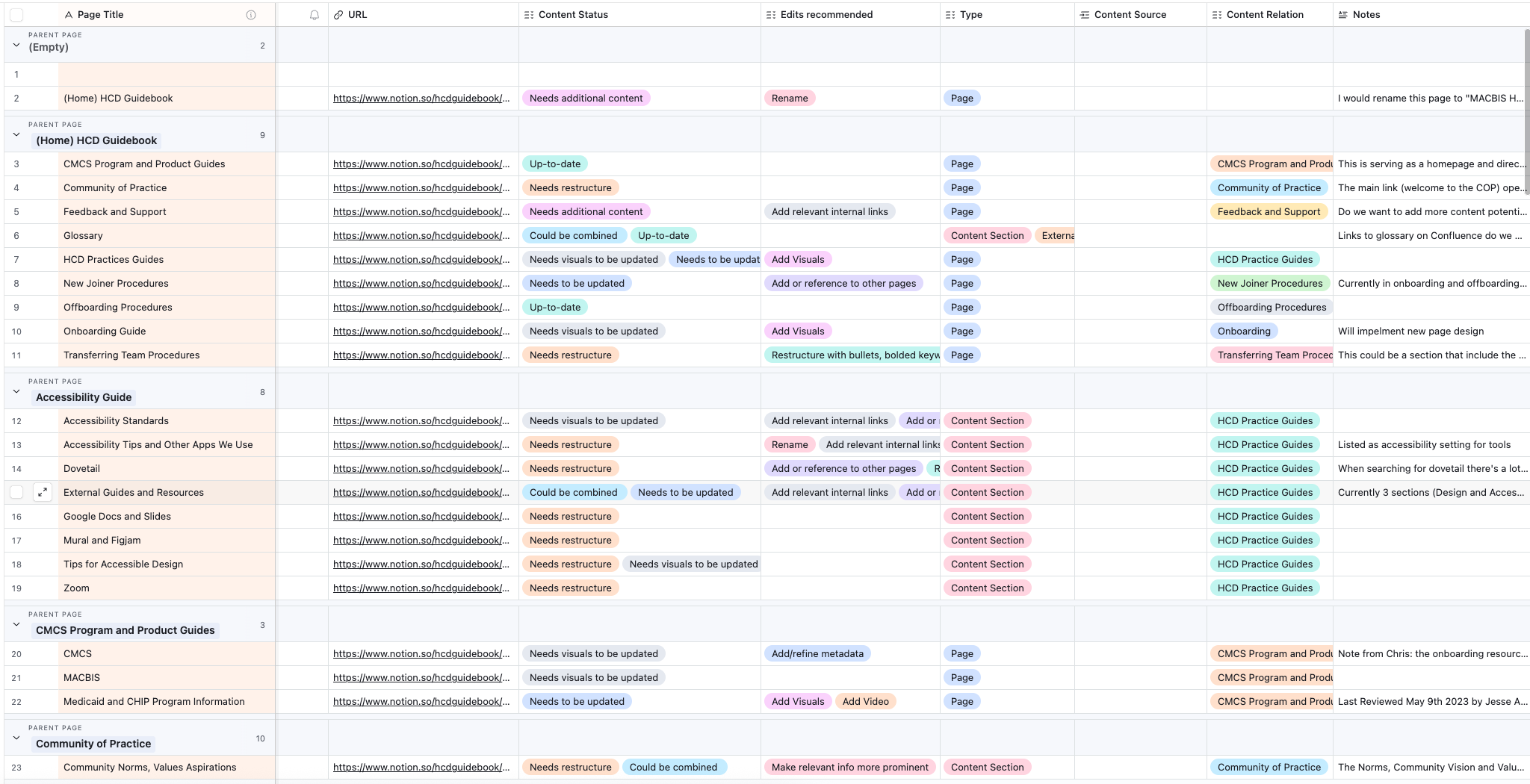
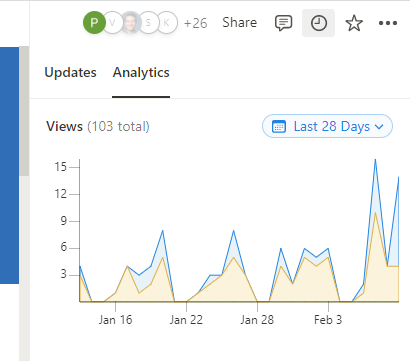
Our team also incorporated page analytics into our redesign strategy, factoring in the built-in Notion page analytics to review page views and overall popularity of different pages in the guidebook. This data shaped how we decided to consolidate and simplify content in our redesign, and in the building of an updated navigation.
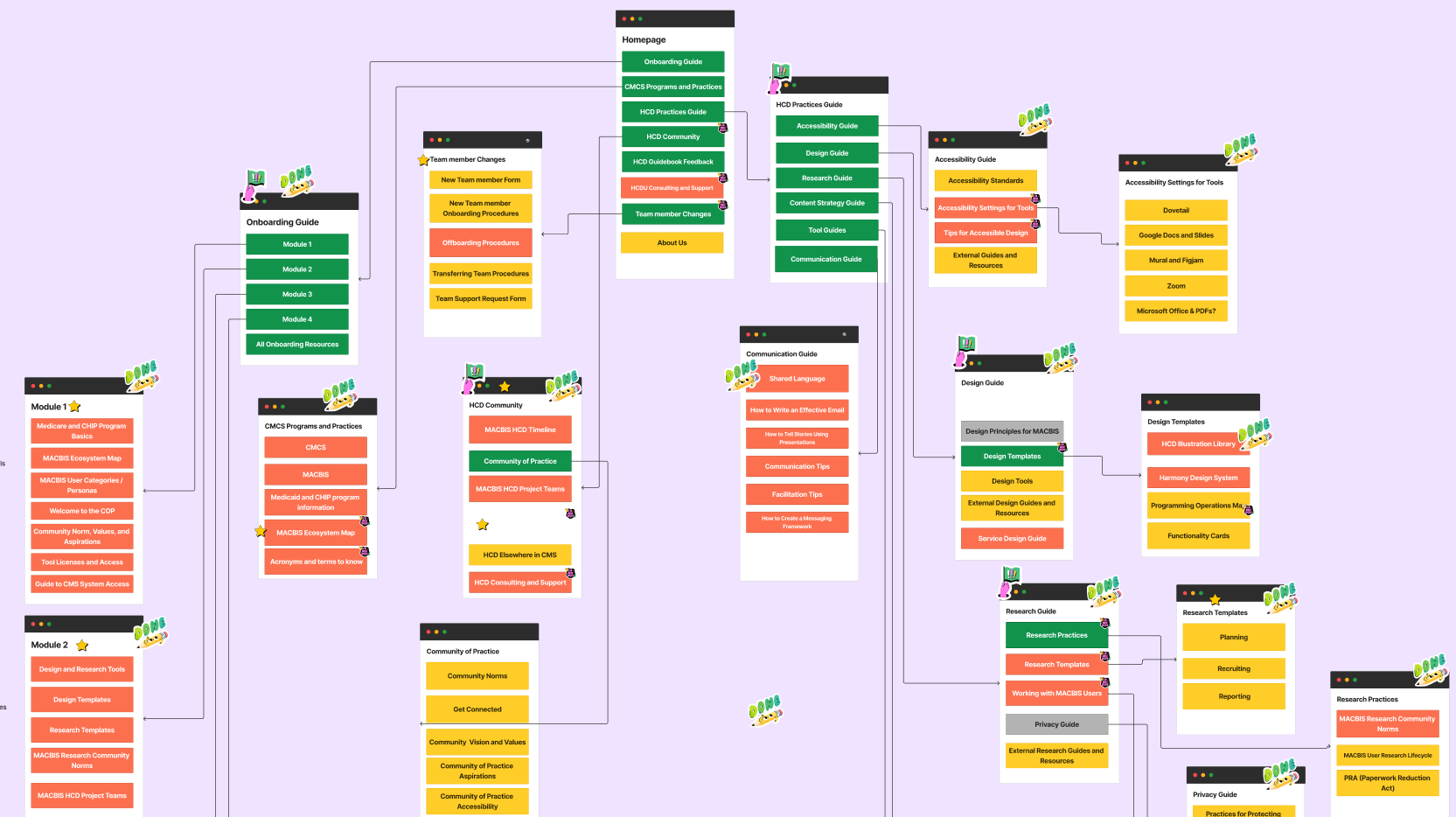
As we progressed through the content audit, we synthesized the feedback received in user interviews, website analytics from previous year of Guidebook use, and our HCDU team’s goals for the guidebook to draft a new guidebook information architecture and navigation. Based on this synthesis, we hoped this new IA and navigation would do the following:
- Create more structure and clearly defined purpose for every stage of onboarding resources
- Emphasize templates and practitioner guides, and make those sections more accessible
- Consolidate resources that are only available after receiving a security clearance, in order to remove unexpected blockers in the user journey
Iterating and Validating with a Tree Test
Once we had drafted an updated IA and navigation for the guidebook, we sought to validate it with MACBIS Practitioners.
We had 11 practitioners participate in a short, 8 question tree test. In this tree test, participants answered questions about how they would look for a specific type of content or take a specific action, using a bare-bones version of our updated IA with the formatting stripped.
In this test, we saw how many participants were able to reach the answer right away, how many were in the right ballpark, and how many were nowhere close to the “correct” destination.
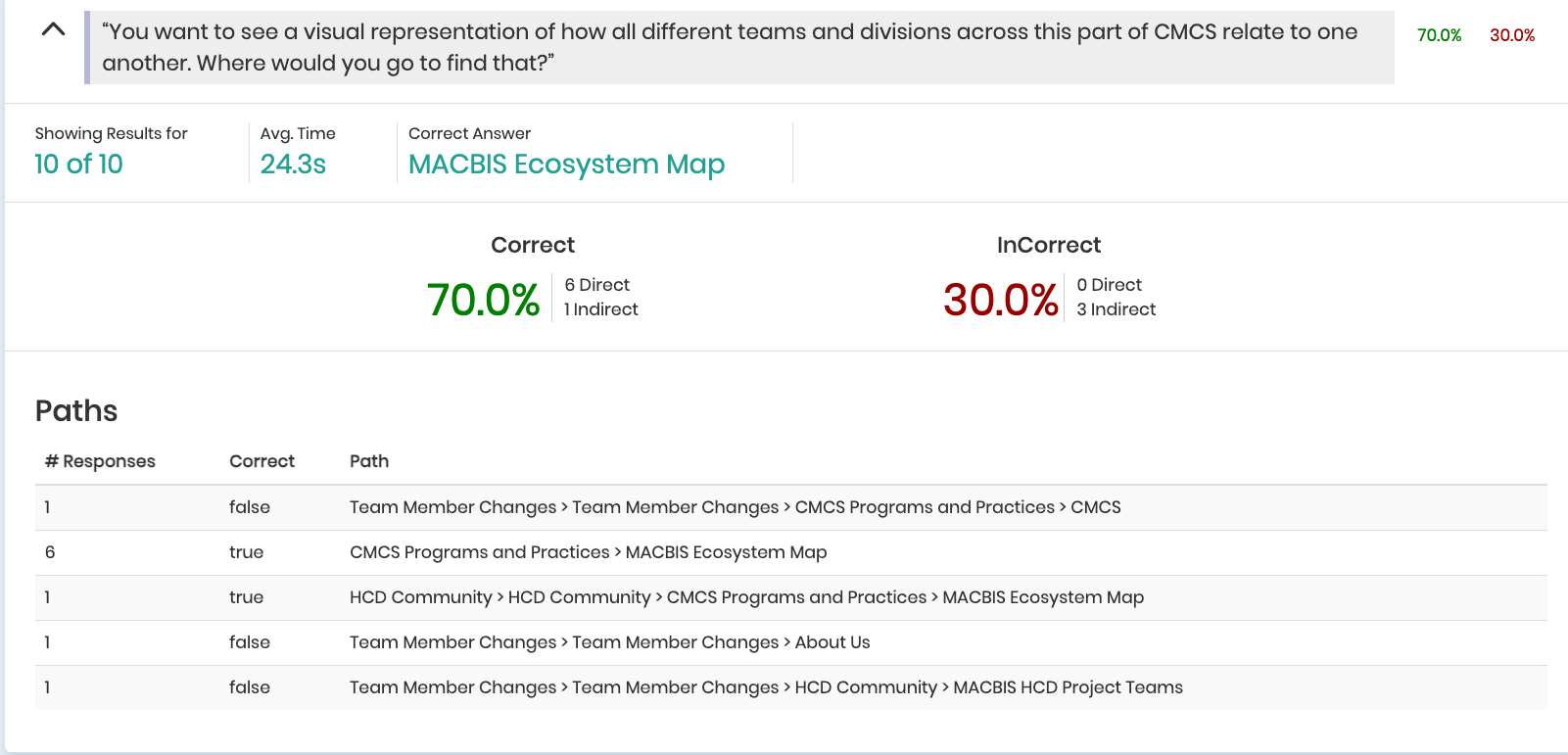
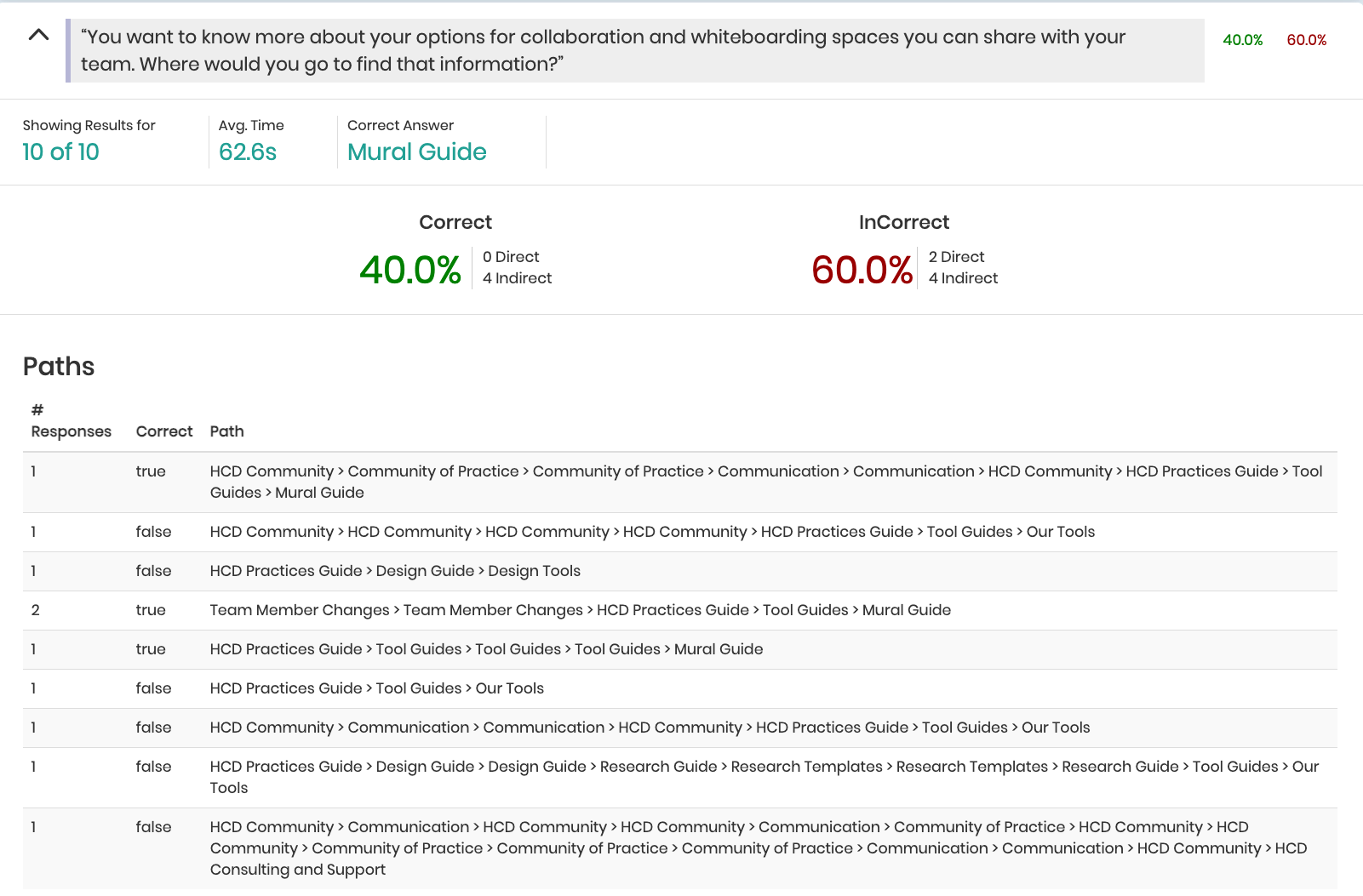
We knew from our discovery research that MACBIS Practitioners were more tech-savvy than the average user, and often had direct bookmarks and links to the pages they used most often. This tree test served as a much needed gut check to how our target users would search for typical guidebook content with an unfamiliar navigation system, without any bookmarks or a searchbar as a crutch.
Overall, the tree test results were mixed. We were pleased to see that the most common and highest value tools and resources were easy to find for our participants. However, our labels and organization for practitioner tools did not test well, and the tasks asking users to navigate to those sections had low success rates.
Following the test, we iterated on our information architecture to address areas of concern, and added in new content, cross-linked resources, and other visual indicators to improve ease of navigation.
Working with Research and Design Constraints
What We Heard
Our tree testing research revealed that when users navigated the guidebook in search of specific content, their navigation patterns were concentrated into two clusters, either the intended path or a single alternative option. This observation helped reassure us that while we were on the right track with our IA, there were specific structural problems we should address.
Two findings stood out in particular:
First, the "Communication Guide" was consistently misread by participants. Without a clear mental model for what lived inside it (a directory of communication tools? Contact info for other teams? Writing resources?) participants hesitated or avoided the section entirely.
Second, practitioners in MACBIS flagged that the guidebook's onboarding modules sometimes conflicted with their smaller team's onboarding instructions, and the value of following the guidebook's version wasn't readily apparent.
Our Constraints
Since the guidebook was hosted and housed in Notion, we had to work within its fixed structure for our solutions. Some of the specific challenges this presented were:
Navigation depth- Since the building blocks of notion are all pages and blocks, we were limited in our ability to create a more traditional IA for navigation. This necessitated multiple layers of nesting to chunk content in a way that was easy to understand and navigate, but it also means users would frequently get lost if too many layers were present, and makes it difficult to pull yourself back out of the nested pages you visited.
Styling and interactivity- Without hover states, tooltips, or interactive UI elements, we couldn't use conventional patterns to contextualize dense content. Instead, we built our own lightweight system using callout blocks, an emoji key, and a consistent color scheme to signal different types of information.
Content library depth- While Notion and it's page building system are universally approachable, they also limited the way we tried to design deeper, more robust content libraries. Research repositories, design templates, and reference materials included in the guidebook had to include extra layers of design and usability consideration to ensure the system would be a useful source of existing content and new contributions.
We also faced a constraint specific to onboarding: our team's relationship to the broader ecosystem. The HCD Unification team was positioned to support other teams, not direct them. As each team continued refining their own onboarding practices, designing a universal guide that remained genuinely useful — rather than contradictory or redundant — required us to be deliberate about how we scoped and framed what the guidebook's modules were actually for.
Developing Solutions
This user feedback and these constraints helped shape our overall design philosophy with the redesigned guidebook.
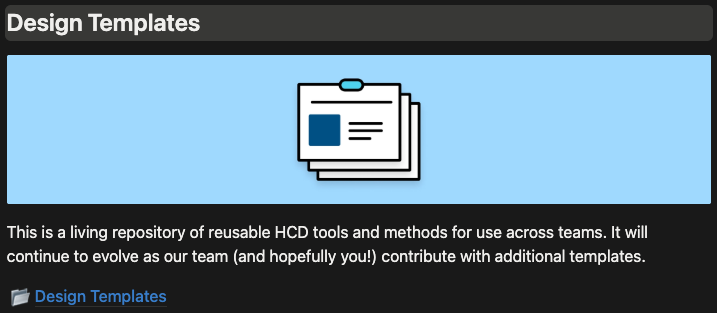
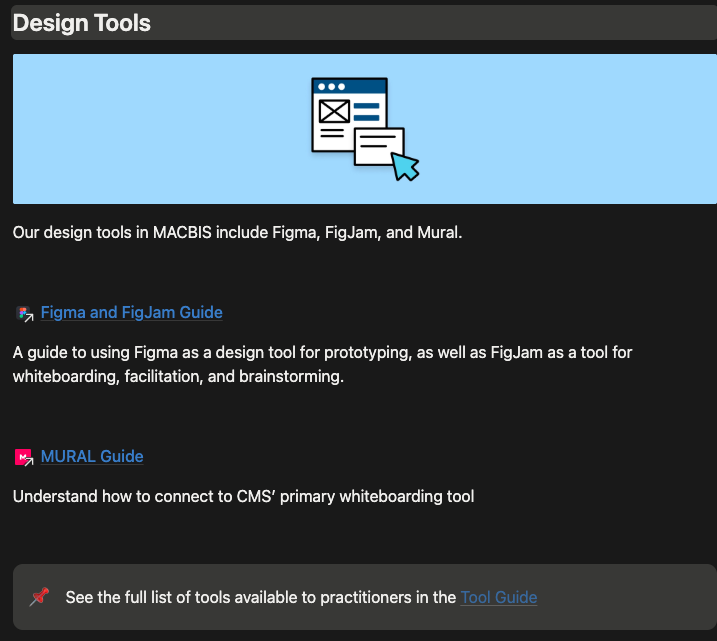
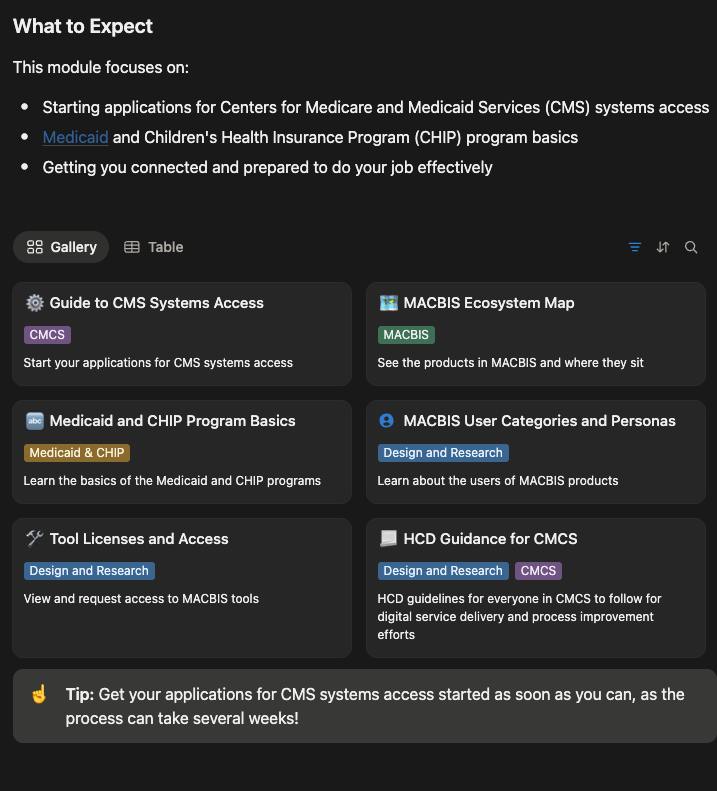
One solution we implemented was "Title cards" for major nested sections
These title cards helped make dense sections of the guidebook more scannable, helped anchor readers as they dove deeper and deeper into nested content, and provided context users were missing about the pages they might be clicking into.
We also incorporated many instances of cross-linking pages and planned redundancy in the guidebook navigation. This helped compensate for the lack of a dedicated navigation bar, and allowed us to cater to user navigation behavior uncovered during tree testing.
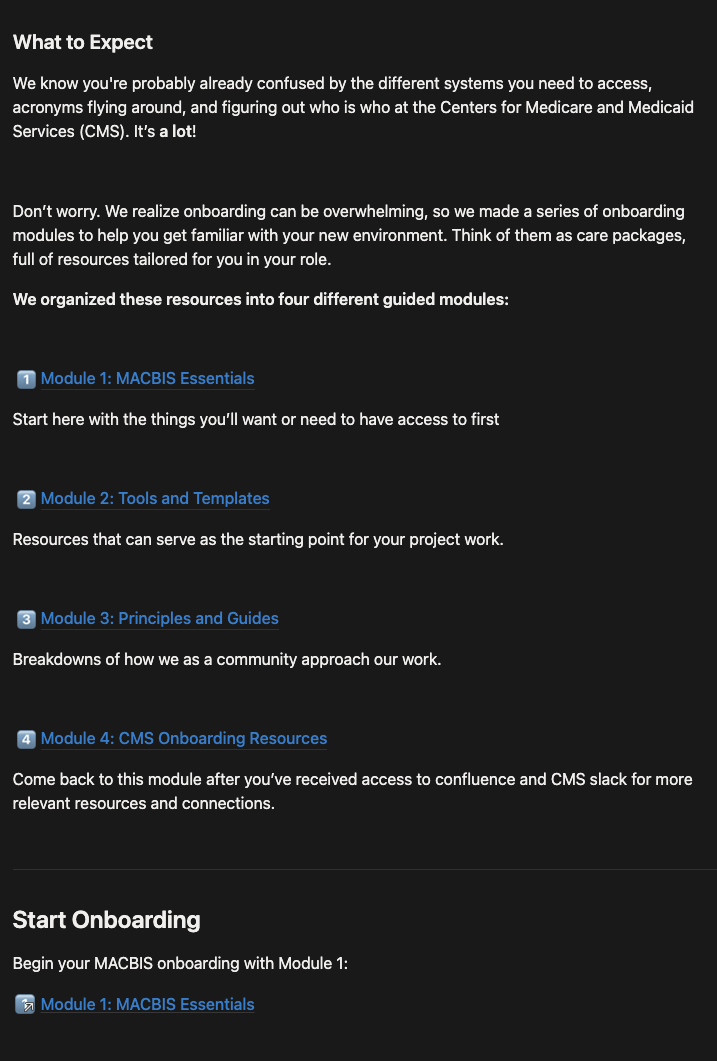
Our onboarding guides were completely redesigned and framed to be less linear by presenting them as "modules" of relevant content that progressed according to access. Our team knew both from user interviews with other practitioners and our firsthand experience that when you join a team on MACBIS, obtaining access to contractor tools and systems is much quicker than obtaining access to government tools and systems. We structured our onboarding "modules" around that concept, ensuring that new joiners could progress naturally through onboarding.
This method also ensured we weren't conflicting with internal team instructions, as our modules were presented as explorations of the MACBIS ecosystem, not checklists for getting started with your day-to-day responsibilities.
Rollout and Results
After countless collaboration sessions, team reviews, and content revisions, the redesigned HCD guidebook launched in the spring of 2024 to the excitement of our HCDU team, CMS leadership, and practitioners across MACBIS. The redesign featured navigation patterns that matched user needs, over 30 relevant guides and templates for research and design, and updated onboarding flows to support newcomers to MACBIS.
As our team continued to support teams across MACBIS, we were relieved to see the excitement around the HCD guidebook was not a flash in the pan. We saw the overall number of page visits to the guidebook increase by 85% over the next 5 months, with particular concentration around our research and design guides. The inclusion of HCD community and HCDU consulting links on the front page increased submissions to our team's intake form by 22% over the next month, which made orchestrating support for teams in MACBIS more efficient and organized. We were often reminded that the value of this project was worth the effort from the frequent praise and appreciation we received from the researchers and designers in MACBIS, and in the ease and efficiency it brought to our team's own design and research work.

Increase in HCD Guidebook page visits

Increase in Research Guide page visits

Increase in HCDU Intake Form Requests
Our HCDU team ended support of this resource in July of 2025, but it is still available to access here: https://hcdguidebook.notion.site